Heritage
“A castle five centuries in the making — and one generation away from being lost.”
The Gaelic Era
Origins & History of an Ancient Gaelic Noble Clan
Prior to the 12th century Norman arrival in Ireland and long before the first stone of Clonony was laid, the Coghlan clan traced its earliest origins to a Gaelic Noble dynasty known as the Uí Cochláin. Mac Cochláin or Ó Cochláin meaning the 'son of the one with the cloak'.
This family name can be traced to the Glendamain (Irish: Glendamnach) ruling dynasty representing the lands of Glanworth, County Cork. Glendamain was active in the province of Munster during the 5th to 11th centuries. It formed one part of a dynastic triumvirate known as the Éoghanachta. These ruling dynasties of Munster aligned to Ireland's Proto Celtic Christian Church and later to the Roman Church. The families vied for control of the High Kingship over the Southern province of Ireland called Munster (Irish: Mumhan).
During the Gaelic Era, family genealogies were incredibly important and were recited orally by the family Bard at official family events and ceremonies. These genealogies followed a temporary patronymic stem, for example Caemh son of Arthur, Arthur son of Cathal, Cathal son of Finnegan and so on. Ireland is considered to be one of the first nations in Europe to drop the temporary patronymic system, exchanging it for the hereditary surnames we have been using until today. This change was likely initiated by the scribes who began summarising extensive genealogies on vellum manuscripts. The Coghlan family receives its name from one such manuscript known as The Speckled Book (An Leabhar Breac).
Contained within The Speckled Book is a polemical tale of an 8th Century King from the aforementioned Glendamain dynasty, Cathal Mac Finguine. This tale is called The Vision of Mac Conglinne (Irish: Aisling Mac Conglaine). It is a dramatised fictional tale alluding to events surrounding a political decision made by King Cathal at The Royal Assembly of Terryglass in 737 A.D.
Gaelic Kings appointed bishops through the presentation of vestment robes, in what is known as an investiture ceremony. The story describes a black robe with golden hem that the King presented to a character named Mac Conglinne becoming known as Cathal of the Cloak (Irish: Cathal Ó Cochall). The family name Cochlán is a derivative of the Irish word cochall, a cloak.
The Norman Era
Displacement & the Building of Clonony
During the Norman era, the family was displaced from East Cork and chose to reestablish their ancient barony known as Delvin Mac Coghlan (Irish: Dealbhna Eathra) in East Munster (Ormond) — in what is now County Offaly.
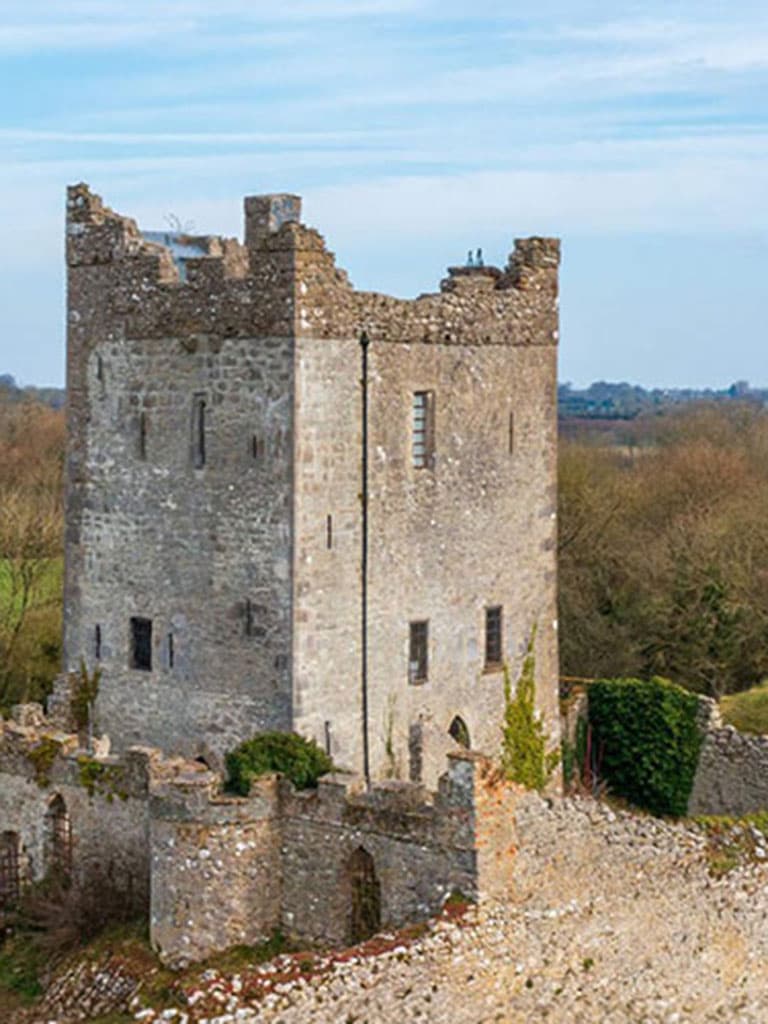
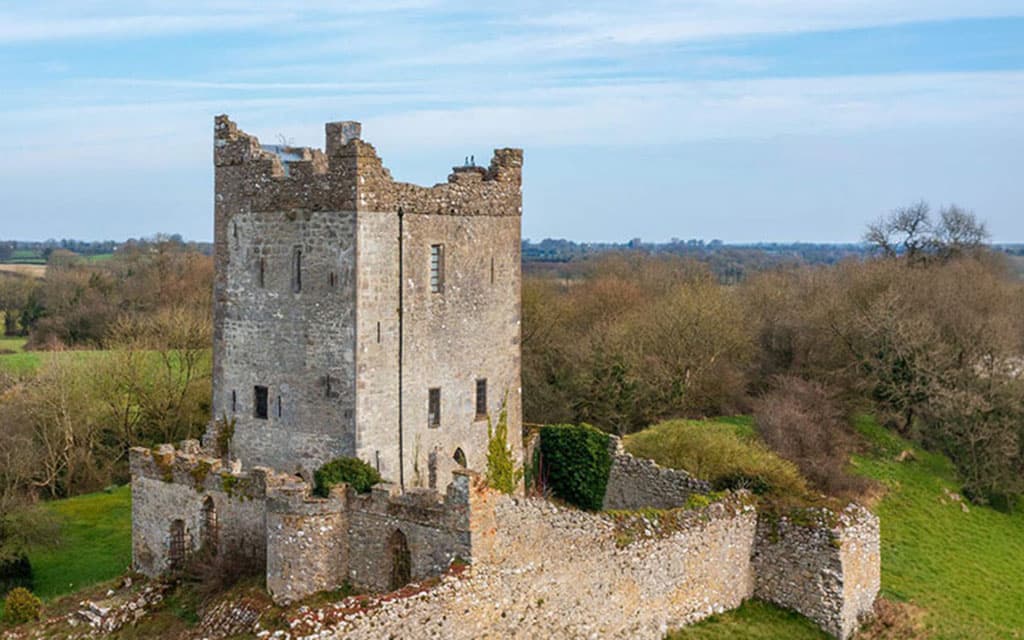
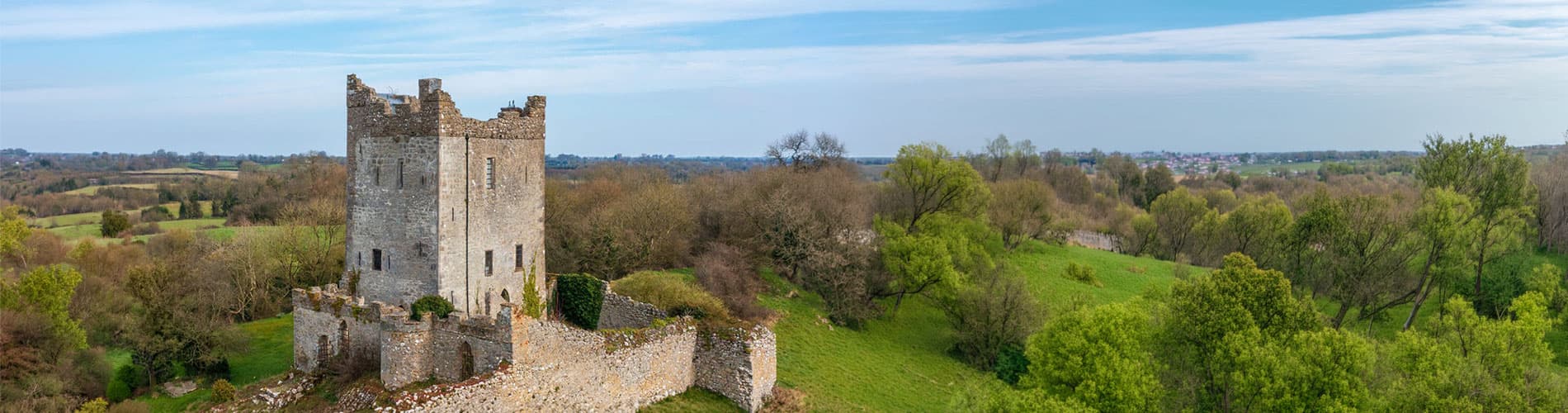
Around the turn of the sixteenth century, the clan erected Clonony Castle — a statement of authority as much as a residence. Built in the robust vernacular style of Hiberno-Norman Ireland, its multi-storey limestone tower rose above the Shannon plain as an unmistakable symbol of power and permanence.
The Tudor Era
Surrender & Regrant
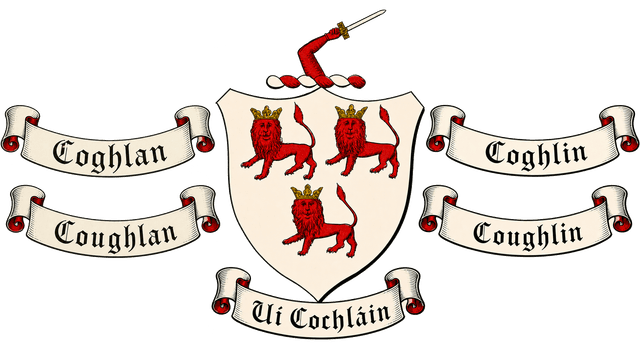
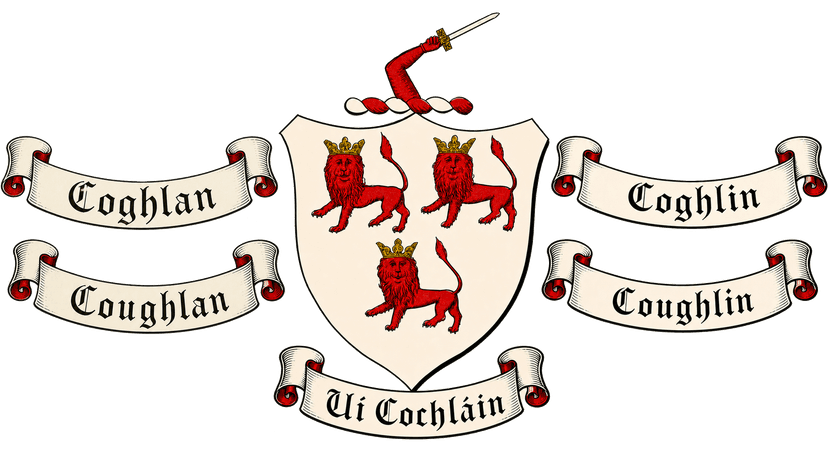
During the Tudor Era, a policy called Surrender and Regrant was enforced by the Crown. This policy required Gaelic clans to surrender their Gaelic names and land titles to then be regranted English names and land titles under royal licence from the Crown. Mac, Uí and Ó are Irish titles meaning 'Son of the Chief' and 'descended from' respectively. The Mac Cochlán clan dropped their titles of Mac and O, anglicising their names in the creation of Coghlan, Coughlan, Coghlin and Coughlin.
The Anglo-Norman Butler Family held the title Earls of Ormond until 1529 when Henry VIII granted this Earldom to Thomas Boleyn, father of Anne Boleyn. Clonony and Delvin, a hitherto Gaelic Chieftaincy found itself drawn into the ever-expanding Earldom of Ormond and the orbit of the tumultuous Tudor court. The Crown's campaign to subdue Gaelic Ireland brought the castle and Clan into direct contact with English power — a world of shifting allegiances and the constant threat of confiscation.
A large Boleyn family tombstone lies beneath a hawthorn tree at the foot of Clonony Castle, bearing the Boleyn family coat of arms and an inscription to Mary and Elizabeth Boleyn. These members of the Boleyn family's presence at Clonony remains one of Ireland's most compelling and least-known Tudor mysteries. The tomb, discovered in 1803, continues to intrigue historians and the Coghlan family alike.
“Here under leys Elisabeth and Mary Bullyn, daughters of Thomas Bullyn, son of George Bullyn the son of George Bullyn Viscount Rochford son of Sir Thomas Bullyn Erle of Ormond and Willsheere.”
The Stuart Era
The De Renzi Letters
Among the most intriguing of the Castle's planted occupants is Sir Mathew de Renzi, a cloth merchant originally from Cologne, Germany. Upon the succession of King James Stuart I to the British throne, de Renzi obtained a land grant of surrendered Mac Coghlan lands in West Offaly; his initial grant of approximately 100 acres grew to over 1000 acres in the following years. He took Clonony Castle as his principal residence.
De Renzi communicated frequently with the British Administration in Dublin denouncing the conduct of the Coghlans who not only continued ploughing de Renzi's acquired lands but also were reneging on their regranted English titles by continuing to practice gavelkind and use their Gaelic title of Mac instead of the English Sire. De Renzi's insightful letters provide excellent color and detail to life in Ireland at that time and include references to an ancient Coghlan family inauguration mound in Ferbane called Ard na Croise.
De Renzi is a fascinating, although conniving character who wrote colorfully to the British Authorities in Ireland on how the Irish noble clans (Irish: Clan na Miledh) could be subdued. De Renzi described Delvin Mac Coghlan as being at 'the very hart and center of the kingdom.' His letters to the Lord Deputy in Dublin Castle provide a rare window into plantation-era Ireland and can be read in the library.
According to his memorial in St. Mary's Church Athlone (re-inserted 1820), de Renzi is credited with creating the first English–Irish dictionary. His epitaph reads: 'He was a great traveller and general linguist, and kept correspondency with most nations in many weighty affairs, and in three years gave great perfection to this nation by composing a grammar, dictionary, and chronicle in the Irish tongue.'
Plantation & Rebellion
The Breaking of Gaelic Ireland
The Flight of the Earls in 1607 marked the effective end of the old Gaelic order. With the Ulster chieftains of the North gone into exile and the Crown's plantation policy accelerating, families like the Coghlans faced mounting pressure on their ancestral lands. The seventeenth century brought successive waves of rebellion, confiscation, and resettlement that reshaped the Irish countryside irrevocably.
It was during the collapse of Gaelic Ireland that the Mac Coghlan clan made its most valuable contribution to the preservation of Irish history and culture by commissioning The Annals of Clonmacnoise in 1627. The Annals were commissioned by the chief of the name, Terence (Toirdhealbhach) Mac Coghlan and compiled by the family Bard, Conall Mag Eochagáin (Connell Mac Geoghan). Mac Geoghan carried out the tedious work of translating and editing what survived of 900 years' worth of manuscripts written by the monks of Clonmacnoise.
The manuscripts document Irish history from 1408 back to pre-Christian times. The Annals were completed on April 20, 1627, at the Castle of Lemanaghan, County Offaly. The original Irish manuscript is now lost. The Annals include a dedication to the Coghlan family, as being among the last to uphold and practice the old Irish tribal customs.
According to family tradition, the Coghlans built many castles in West Offaly; Clonony is the only one that remains standing today. A historical map of Coghlan castles and territories can be viewed in the library.
According to family tradition, the Coghlan family built many castles in West Offaly — Clonony is said to be the only one still standing
Sacred Patronage
Clonmacnoise
For centuries, powerful Gaelic families acted as patrons and protectors of Ireland's major monasteries. Modern Coughlans often assume the family was simply another Irish sept, but the annals suggest something more substantial.
The Mac Cochláins were effectively the ruling dynasty of a small Gaelic kingdom that controlled a strategic stretch of the Shannon basin for hundreds of years. By the time the Annals of Clonmacnoise were translated in 1627, the family represented one of the last surviving links to the old Gaelic order in the Midlands.
The Mac Cochláins appear to have been among the principal secular powers surrounding Clonmacnoise. This patronage involved providing protection, supporting ecclesiastical lands financially, interacting with abbots and church officials, influencing local politics around the monastery. A visit to Clonmacnoise Cathedral and the many family tombs within it will attest to this fact.
The Georgian Era
Thomas McCoghlan, MP
During the Georgian Era, the Family and County was represented in the British Parliament by Thomas McCoghlan.
“Proud, satirical, gallant & hospitable, his habits were expensive and he adhered to all the National customs of his ancestors. His tenants held their land at will & paid rent in money or kind. His doors were ever open to the traveller or the stranger as was the custom of the old Irish. He practised the Brehon Code & held his court in Cloghan, which was presided over by a Seneschal. He also operated an Inn, in the Stage Coach days, called 'The Coghlan's Arms'. Thomas died in 1790 leaving no legitimate representative to inherit his title.”
— Contemporary description of Thomas McCoghlan, MP
Silence & Survival
A Ruin That Refuses to Be Forgotten
When Thomas McCoghlan died in 1790 without a legitimate heir, Clonony Castle began its long descent into ruin. The castle that had stood as a symbol of Gaelic power for nearly three centuries was gradually abandoned, its walls exposed to the elements, its halls silent.
For over two hundred years, the castle stood empty — a haunting reminder of a vanished world. Ivy crept up its walls, trees took root in its chambers, and the Irish midlands reclaimed what stone and mortar had briefly held at bay. Yet unlike so many Irish castles that collapsed entirely or were quarried for building materials, Clonony endured.
The castle became a landmark in the landscape, a place of memory for the Coghlan diaspora scattered across the world. Generations of family members returned to stand in its shadow, to trace their ancestry back to these walls, to feel the weight of five hundred years of history pressing down through stone.
Today, Clonony Castle stands at a crossroads. A rare opportunity has emerged to return the castle to the Coghlan family and ensure it is preserved for future generations. What was once a symbol of loss may yet become a symbol of renewal — a testament to the resilience of heritage, and to a family's determination to honor the past while securing the future.
Five Centuries at a Glance
- 5th Century
The Glendamain (Glendamnach) dynasty is active in Munster, representing the lands of Glanworth, County Cork. Origins of the Uí Cochláin.
- 737 A.D.
King Cathal Mac Finguine presides at the Royal Assembly of Terryglass. The family name Cochlán — from the Irish cochall, a cloak — derives from this era.
- c. 1169
The Norman arrival in Ireland. The Coghlan family is displaced from East Cork and reestablishes Delvin Mac Coghlan (Dealbhna Eathra) in what is now County Offaly.
- c. 1500
Clonony Castle erected by the Mac Coghlan clan as their principal tower house in West Offaly.
- 1529
Henry VIII grants the Earldom of Ormond to Thomas Boleyn, father of Anne Boleyn, drawing Clonony into the Tudor orbit.
- 1607
The Flight of the Earls marks the effective end of the old Gaelic order.
- 1627
The Annals of Clonmacnoise commissioned by Terence Mac Coghlan, compiled by Connell Mac Geoghan in the Castle of Lemanaghan.
- 1803
The Boleyn family tombstone said to have been discovered beneath a Hawthorn Tree at the foot of Clonony Castle.
- Today
The Coghlan family launches a campaign to preserve Clonony Castle for future generations.
Be Part of the Next Chapter
Five hundred years of history stands at a turning point. Help the Coghlan family secure Clonony Castle and ensure its story continues for generations to come.